Deborah Kruger
art@deborahkruger.com
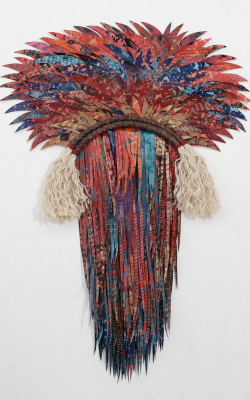
The impetus behind creating Butterfly Effect was a call for installations on the theme of AIR for the World Textile Association Biennial Fiber Conference, conveniently held this year in Mexico City. Given that my artwork is all related to birds and feathers, I readily took up the challenge.
The title refers not to butterflies, but to the theory developed by American mathamatician and meteorologist, Edward Lorenz (1917 - 2008), whose pioneering research in chaos theory explains how seemingly inconsequential action can have a profound ripple effect on large systems. The most well known example, which he coined the Butterfly Effect, is how the fluttering of a butterfly wing could theoretically cause a typhoon on the other side of the world. I developed this piece to illustrate the Butterfly Effect Theory both in concept and construction.
The urge to prosper and grow is intrinsically human, but in fact, without thoughtful mediation, that impulse carries within it the seeds of our own destruction. The human drive to populate, settle, build and grow has concurrently meant a geometrically equivalent decrease in bird habitat. While non-birders might scoff at this seemingly insignificant side effect of development, the outcome has come back to haunt everyone, even the most ardent city dweller.
The decrease in habitat creates the following scenarios:
- Less nesting habitat leads to decrease in bird populations
- Decrease in bird populations results in the increase of insects (bird food)
- Loss of natural control of insects leads to significantly increased threats to agricultural production
- Threats to agriculture dramatically increase the production of petro-chemical based insecticides that concurrently increase our dependence on oil, pollute our fresh water, and enter our eco-system causing additional threats to bird populations (and humans and other living things)
- Frantic (and non-7 generation) development of insecticides has not kept up with agricultural threats and we are therefore seeing less successful and more expensive agricultural production and is considered part of the reason for bee colony collapse which has its own frightening impact on agriculture
And so the simple urge to expand has had a cataclysmic affect on our ecological health, our access to affordable food and our geopolitical safety.
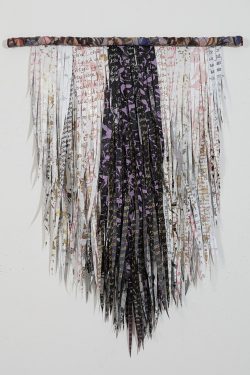
The Butterfly Effect installation is composed from hundreds of feathers suspended in air, the element that connects all things and beings and the installation is designed to quiver and vibrate in response to slightest air current. Even as the viewer approaches the piece, it will move and respond to their presence. Hopefully, the art will also have a similar effect on the viewer.
The feather elements in this installation piece are fabricated from computer scans of the original feathers made from fiber, encaustic, oilstick and paint, materials that would not easily endure heat and airborne dust. The scans are inkjet printed on 300 lb watercolor paper along with paint and oilstick that are fixed and molded with acrylic coating.
We all exist in air and space and the concept behind this piece is to make us more aware of the subtle impact that we all have, both physically and energetically on the world around us.Perhaps a deeper awareness of this invisible but ever present interconnection can lead to a more harmonious and thoughtful level of interactivity between all entities that share the world’s airspace.
Butterfly Effect will be on view at the Diego Rivera Museum in Mexico City from May 26 - July 22, 2011. For more information: www.wta-online.org